This is my most recent cake using the cake of the month recipe. Lemon-yumminess.
Saturday, May 21, 2011


Comment on the recipe of the month
I recently was requested to do a lemon cake with lemon filling. So, I thought I would try out a new recipe using the recipe of the month. I was not disappointed.
First, I used Duncan Hines Moist Deluxe Lemon Cake mix and sifted the dry mix with 1 cup of flour, 1 cup of sugar, and 1 large box of Jell-O lemon pudding mix.
Second, I mixed together in another bowl the water, oil, sour cream, egg, and lemon extract.
Third, I combined the two separate bowls, and I mix just until the liquid is absorbed in the dry ingredients. I scrape down the bowl, and I mix again just until the mix looks silky. Then I pour into my prepared cake pans (pans sprayed with non-stick spray and lined with wax paper or parchment paper). Bake at 325 degrees until a toothpick comes out with just a few crumbs on it.
I level using the tea towel method (see previous post) and cover the pan with aluminum foil after they have almost cooled completely in the pan. This will make the cake more moist (however, only do this if the cake will be used right away the extra moisture could make the cake go bad more quickly). Tort you cake and fill with lemon filling with a buttercream dam.
To make your lemon filling use the juice and zest from 3 large lemons, 1 cup of sugar, 4 eggs and 1/2 cup butter. Place zest and sugar in a food processor and process until combined. Add lemon juice and eggs and process until smooth. Slowly add the butter to the mixture, pulsing as you go. Place in the top of a double bowler and cook over simmering water until thickened (about 5 minutes). Let the mixture cool completely. To apply to cake, using thick buttercream, make a dam around the outside edge of the torted cake (about a 1/4 of an inch from the outside edge) place the filling inside the dam. Place top layer on cake. Apply your crumb-coat (some call this dirty icing which just means to apply a thin layer of icing all over the cake to prevent crumbs from getting into your final icing.
Once you have applied your crumb-coat and allowed it to crust, you can apply your final coat of icing. The thickness will depend on whether you are adding fondant or just using buttercream. If I am applying fondant, I use a thinner layer of buttercream to prevent it from squishing from under the fondant. I apply a slightly thicker layer if I am using only buttercream.
Once the buttercream has crusted, you can apply your rolled out fondant. Smooth the fondant according to the fondant smoothing techniques I have posted in this blog. I made the lemon fondant by making marshmallow fondant and adding LorAnn Oils to it. Melt a 10 ounce bag of marshmallows with a tablespoon of water in the microwave for about 2 minutes (stirring after about 1 minute...*note this is important as it keeps the gelatin in the marshmallows from coagulating on the bottom of the bowl). Remove from microwave and add your flavoring and coloring. Stir in powdered sugar until it forms a stiff playdoh-type fondant. Let rest overnight before using (Note: this is also important, because the fondant will completely absorb the sugar and is easier to work with). Decorate as desired.
This was absolutely yummy.
First, I used Duncan Hines Moist Deluxe Lemon Cake mix and sifted the dry mix with 1 cup of flour, 1 cup of sugar, and 1 large box of Jell-O lemon pudding mix.
Second, I mixed together in another bowl the water, oil, sour cream, egg, and lemon extract.
Third, I combined the two separate bowls, and I mix just until the liquid is absorbed in the dry ingredients. I scrape down the bowl, and I mix again just until the mix looks silky. Then I pour into my prepared cake pans (pans sprayed with non-stick spray and lined with wax paper or parchment paper). Bake at 325 degrees until a toothpick comes out with just a few crumbs on it.
I level using the tea towel method (see previous post) and cover the pan with aluminum foil after they have almost cooled completely in the pan. This will make the cake more moist (however, only do this if the cake will be used right away the extra moisture could make the cake go bad more quickly). Tort you cake and fill with lemon filling with a buttercream dam.
To make your lemon filling use the juice and zest from 3 large lemons, 1 cup of sugar, 4 eggs and 1/2 cup butter. Place zest and sugar in a food processor and process until combined. Add lemon juice and eggs and process until smooth. Slowly add the butter to the mixture, pulsing as you go. Place in the top of a double bowler and cook over simmering water until thickened (about 5 minutes). Let the mixture cool completely. To apply to cake, using thick buttercream, make a dam around the outside edge of the torted cake (about a 1/4 of an inch from the outside edge) place the filling inside the dam. Place top layer on cake. Apply your crumb-coat (some call this dirty icing which just means to apply a thin layer of icing all over the cake to prevent crumbs from getting into your final icing.
Once you have applied your crumb-coat and allowed it to crust, you can apply your final coat of icing. The thickness will depend on whether you are adding fondant or just using buttercream. If I am applying fondant, I use a thinner layer of buttercream to prevent it from squishing from under the fondant. I apply a slightly thicker layer if I am using only buttercream.
Once the buttercream has crusted, you can apply your rolled out fondant. Smooth the fondant according to the fondant smoothing techniques I have posted in this blog. I made the lemon fondant by making marshmallow fondant and adding LorAnn Oils to it. Melt a 10 ounce bag of marshmallows with a tablespoon of water in the microwave for about 2 minutes (stirring after about 1 minute...*note this is important as it keeps the gelatin in the marshmallows from coagulating on the bottom of the bowl). Remove from microwave and add your flavoring and coloring. Stir in powdered sugar until it forms a stiff playdoh-type fondant. Let rest overnight before using (Note: this is also important, because the fondant will completely absorb the sugar and is easier to work with). Decorate as desired.
This was absolutely yummy.
Friday, April 22, 2011
Trying out the Lambeth Method
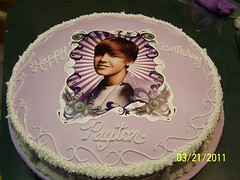
Well I finally got around to trying some of the Lambeth techniques (So to speak) on a cake for my granddaughter. Well kinda sort of. I didn't have a lot of time so I used a couple of the decorating techniques, but not in layers. After trying some of the icing methods I am even more determined to try some of these techniques. I just wish you could find more information about it on the internet. Classes really aren't an option for me at all right now. Oh well, I am getting off topic. I really like the looks of this on a cake, and I will be trying some more intricate stuff as I get the chance. Tell me what you think.
Monday, April 11, 2011
I can't believe it has been almost a month since my last post.
I have been so busy with work that I haven't had a chance to make any posts to my blog. I feel like I am really neglecting my followers. I do have a little good news though. I did manage to make a couple of cakes since my last post. The bad news is that I can't post them on my blog.
I did a couple of naughty cakes for a couple of friends. I don't particularly like doing these types of cakes, but I always feel obligated to give my friends what they ask for to a certain degree.
I don't post them to my blog, because I don't have any way of censoring who might see them. I usually post them to cakecentral.com, because they have a naughty forum. I realize that this doesn't prevent someone from seeing them that wants to badly enough, but if I were to post them here on my blog they would be out where anyone could see them.
So if you would like to see these two cakes, I apologize, but you will have to visit the naughty forum on cakecentral.com under cabecakes.
But at least I did get to make a couple of cakes. I'm surprise given the hours my company has had us working.
I do promise to try and be more diligent in the future about trying to post some new information for my followers though, and if you should have any questions regarding any of my cakes don't hestitate to ask.
I did a couple of naughty cakes for a couple of friends. I don't particularly like doing these types of cakes, but I always feel obligated to give my friends what they ask for to a certain degree.
I don't post them to my blog, because I don't have any way of censoring who might see them. I usually post them to cakecentral.com, because they have a naughty forum. I realize that this doesn't prevent someone from seeing them that wants to badly enough, but if I were to post them here on my blog they would be out where anyone could see them.
So if you would like to see these two cakes, I apologize, but you will have to visit the naughty forum on cakecentral.com under cabecakes.
But at least I did get to make a couple of cakes. I'm surprise given the hours my company has had us working.
I do promise to try and be more diligent in the future about trying to post some new information for my followers though, and if you should have any questions regarding any of my cakes don't hestitate to ask.
Saturday, March 19, 2011
Another great caking site
I just found the most amazing caking site, and it has a lot of recognized names in caking. Edna De La Cruz, Sharon Zambito, Sif Jensen and others. I just wanted to let you know about this site. It is too cool and has a lot of info. It is called Sugar Teachers, Cake Decorating, and Sugar Art Tutorials, and it can be found by clicking here.
Tuesday, March 8, 2011
Different styles of Buttercream
I don't know if you are aware, but there are different types of buttercream. I know of at least 4 types. They are American Buttercream, Italian Meringue Buttercream, Swiss Meringue Buttercream and French Buttercream.
With the first, our traditional buttercream, usually one would use a combination of shortening and butter mixed with a flavoring such as vanilla and powdered sugar. If it were a crusting buttercream, it would likely also contain some meringue powder.
With Italian Meringue Buttercream you would heat sugar and water to about 238 degrees while mixing egg whites and cream of tartar to stiff peaks. Once the sugar reaches the proper temperature you would slowly add the sugar syrup to the egg whites and beat until the bowl is just warm to the touch. Then one would add chunks of butter a little at a time and whip until smooth. Warren Brown of Cake Love has a really good video for this on youtube.
Then you have what is known as Swiss Meringue Buttercream, which in some aspects is similar to Italian Meringue Buttercream. And the best thing I can do is point you in the direction of a blog called From Scratch Sf, because she has already done all the work for you in this wonderful picture tutorial. You may want to check it out if you are interested in trying another type of buttercream. She says that I can link to her page, so you can share in her tutorial. So thank you so much for sharing.
And lastly, French Buttercream one would beat egg yolks in a mixer and while mixing eggs also combine sugar and water in saucepan and cook to 238 degrees. Pour into yolks with mixter running and mix on med speed until the mixture reaches room temperature. Add butter a little at a time. You can also add water to smooth the consistency a little. I will try to get an actual recipe for this one to share with you. I have messaged someone in regards to this, but I am still waiting for a reply. I will edit this post if she gives me permission to use her recipe.
I would imagine there are probably many variations that I am unaware of, and if there are, I hope someone shares them with us. I just thought I would let you know a little about the ones I am aware of.
With the first, our traditional buttercream, usually one would use a combination of shortening and butter mixed with a flavoring such as vanilla and powdered sugar. If it were a crusting buttercream, it would likely also contain some meringue powder.
With Italian Meringue Buttercream you would heat sugar and water to about 238 degrees while mixing egg whites and cream of tartar to stiff peaks. Once the sugar reaches the proper temperature you would slowly add the sugar syrup to the egg whites and beat until the bowl is just warm to the touch. Then one would add chunks of butter a little at a time and whip until smooth. Warren Brown of Cake Love has a really good video for this on youtube.
Then you have what is known as Swiss Meringue Buttercream, which in some aspects is similar to Italian Meringue Buttercream. And the best thing I can do is point you in the direction of a blog called From Scratch Sf, because she has already done all the work for you in this wonderful picture tutorial. You may want to check it out if you are interested in trying another type of buttercream. She says that I can link to her page, so you can share in her tutorial. So thank you so much for sharing.
And lastly, French Buttercream one would beat egg yolks in a mixer and while mixing eggs also combine sugar and water in saucepan and cook to 238 degrees. Pour into yolks with mixter running and mix on med speed until the mixture reaches room temperature. Add butter a little at a time. You can also add water to smooth the consistency a little. I will try to get an actual recipe for this one to share with you. I have messaged someone in regards to this, but I am still waiting for a reply. I will edit this post if she gives me permission to use her recipe.
I would imagine there are probably many variations that I am unaware of, and if there are, I hope someone shares them with us. I just thought I would let you know a little about the ones I am aware of.
Sunday, February 27, 2011
Sorry I haven't been posting!
I have been working a lot of overtime recently, so this has prevented me from being as diligent on my blog as I would like to be.
Nonetheless, I am happy to announce my new passion for cake techniques. There is a method of decorating that has survived the over many years called the Lambeth Method of Decorating. These cakes are phenominal.
In the Lambeth method, royal icing is placed in layers upon layers in intricate designs over fondant. The effect is spectacular. The traditionalism of such work is what attracts me to this method I think. To look at it, you can picture yourself in an earlier time long ago...true Victorianism at its best. But this is beauty that can't be described. You just have to see it to appreciate it.
I would like you to know up front that I did not create this cake. This cake was done by a cakecentral.com member called Gefion. I think the work is so fantastic, and I really would like you to see the craftsmanship that went into this cake. I would also like to note that this technique is very time and labor intense, so you would know how much work went into making this cake.

This is true cake designing at its best, and I would really love to learn this technique. I'll let you know what I learn when I do.
Edited to add: I just had to add this to my post for those, like myself, that are interested in this method. I found a couple tutorials. Sif Jensen was kind enough to post a tutorial on this method. Here is a link to the site. Also, I found this link as well. I hope these will help you all out. They don't go into it extensively, but it will give you a general idea and maybe give you a starting framework to work with. I hope this helps. I know I am going to try this out the first chance I get.
Nonetheless, I am happy to announce my new passion for cake techniques. There is a method of decorating that has survived the over many years called the Lambeth Method of Decorating. These cakes are phenominal.
In the Lambeth method, royal icing is placed in layers upon layers in intricate designs over fondant. The effect is spectacular. The traditionalism of such work is what attracts me to this method I think. To look at it, you can picture yourself in an earlier time long ago...true Victorianism at its best. But this is beauty that can't be described. You just have to see it to appreciate it.
I would like you to know up front that I did not create this cake. This cake was done by a cakecentral.com member called Gefion. I think the work is so fantastic, and I really would like you to see the craftsmanship that went into this cake. I would also like to note that this technique is very time and labor intense, so you would know how much work went into making this cake.

This is true cake designing at its best, and I would really love to learn this technique. I'll let you know what I learn when I do.
Edited to add: I just had to add this to my post for those, like myself, that are interested in this method. I found a couple tutorials. Sif Jensen was kind enough to post a tutorial on this method. Here is a link to the site. Also, I found this link as well. I hope these will help you all out. They don't go into it extensively, but it will give you a general idea and maybe give you a starting framework to work with. I hope this helps. I know I am going to try this out the first chance I get.
Subscribe to:
Posts (Atom)